Menu-Order-AI helps GLP-1 users decide what to order from any menu in real time—without stress or guesswork.
For many people using GLP-1, eating didn’t stop—but ordering changed. What used to feel automatic now requires more thought. Menus feel longer. Descriptions feel vague. Portions feel unpredictable. And the moment of ordering, especially in social settings, can suddenly feel uncomfortable.
This isn’t about willpower or discipline. It’s about decision friction.
This guide explains why ordering feels harder for GLP-1 users, what people are actually looking for when they open a menu, and how real-time menu clarity restores confidence, speed, and enjoyment—whether dining out or ordering in.
Why Menus Feel Harder After Starting GLP-1
GLP-1 changes how people relate to food, but menus haven’t changed to reflect that.
Restaurant menus are designed to showcase everything a kitchen can offer. They are not designed to help someone quickly identify what fits their preferences in the moment. For GLP-1 users, this gap becomes obvious almost immediately.
Many people experience:
- Longer pauses before ordering
- Re-reading menu descriptions multiple times
- Asking more questions than usual
- Defaulting to something familiar just to avoid uncertainty
The pressure is subtle but real. Ordering is public. Friends are waiting. Servers are standing nearby. And the internal question becomes, “What actually works for me right now?”
The problem isn’t the food.
The problem is lack of clarity at the point of decision.
How GLP-1 Changes Ordering Behavior (Not Eating Habits)
GLP-1 users don’t suddenly need strict rules. What changes is how decisions feel.
Ordering behavior often shifts toward:
- Wanting simpler, more predictable options
- Prioritizing protein without overanalyzing
- Avoiding dishes that feel heavy or unclear
- Choosing familiarity over experimentation
This doesn’t mean people stop enjoying restaurants. It means the decision process needs to be faster and clearer than before.
Menus don’t adapt to this shift. They still require interpretation, comparison, and guesswork—none of which are helpful in a real-time dining environment.
GLP-1 users don’t need more information.
They need less friction.
What GLP-1 Users Are Actually Looking for on Menus
When preferences shift, clarity becomes the priority.
Most GLP-1 users aren’t searching for perfection. They’re looking for:
- Options that clearly align with how they want to eat
- Meals that feel manageable and intentional
- Choices that don’t require mental math or assumptions
This usually translates to scanning menus for:
- Protein-forward options
- GLP-1-friendly choices
- Lighter or lower-carb preparations
- Straightforward descriptions
Manually identifying these patterns—every time, on every menu—creates fatigue. The decision becomes harder than it needs to be.
Menu-Order-AI exists to eliminate that friction by making preferences visible instantly.
What Happens When Menu Clarity Is Missing
Without real-time guidance, many GLP-1 users start to disengage from dining—not because they don’t want to eat out, but because the experience feels stressful.
Common behaviors include:
- Skipping meals entirely
- Ordering something random just to move on
- Feeling disconnected in social settings
- Avoiding restaurants unless absolutely necessary
Over time, this changes how people show up. Dining becomes something to manage instead of something to enjoy.
This isn’t about control or restriction.
It’s about confidence at the table.
When people feel confident ordering, they stay engaged. When they don’t, they withdraw.
How Menu-Order-AI Works in Real Time
Menu-Order-AI is designed for the exact moment ordering decisions happen.
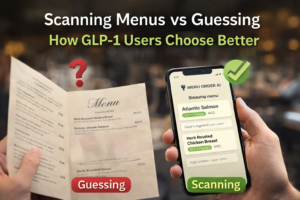
Instead of asking users to interpret menus, the app does the work instantly.
The experience is simple:
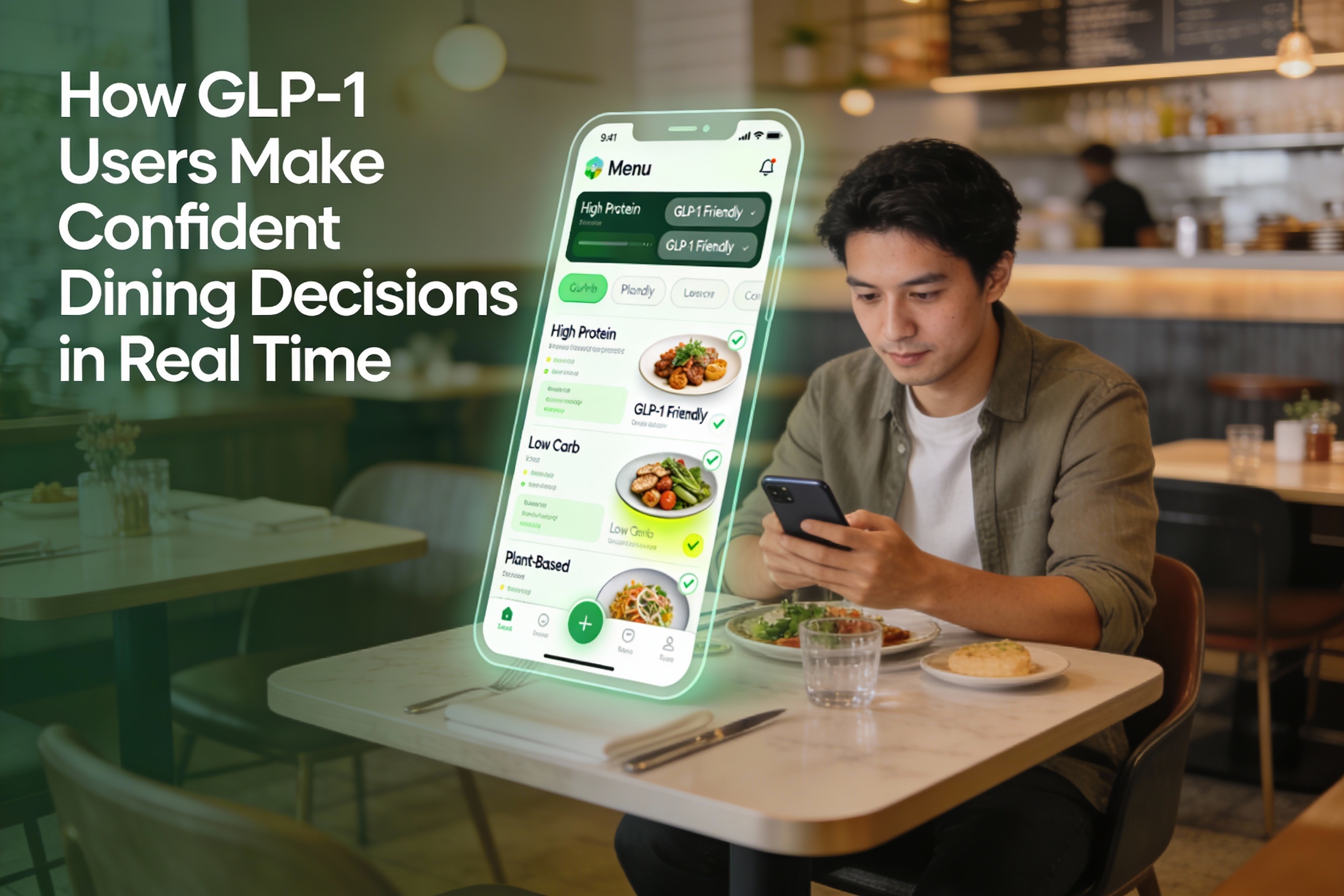
- Open Menu-Order-AI at the table or before ordering
- Scan a menu or choose a restaurant
- Select GLP-1-aligned preferences
- Instantly see prioritized options that fit
There’s no need to decode descriptions, scroll endlessly, or second-guess choices. The app surfaces clarity first, so decisions feel easy again.
This isn’t about telling people what to eat.
It’s about helping them see what fits.
Ordering Out, Ordering In, Traveling—Same Decision Flow
Dining decisions don’t only happen at restaurants.
Menu-Order-AI supports:
- Dining out with friends
- Ordering delivery
- Takeout
- Travel dining
- Unfamiliar menus in new places
This consistency is what restores confidence. People don’t have to relearn how to order every time they’re in a new situation.
Where you eat changes.
How confident you feel doesn’t have to.
Why Confidence Matters More Than Control
The goal isn’t perfect ordering.
The goal is comfortable ordering.
When clarity is present:
- Decisions happen faster
- Overthinking disappears
- Social moments feel natural again
- Dining becomes enjoyable instead of stressful
Menu-Order-AI doesn’t remove choice.
It removes uncertainty.
This isn’t restriction.
It’s intention—without overwhelm.
The Future of Dining for GLP-1 Users
As GLP-1 adoption grows, dining doesn’t disappear—it evolves.
People still want to eat out.
They still want to order with friends.
They still want food to feel normal.
What changes is the need for clarity in the moment.
Menus may not adapt quickly, but tools can.
The future of dining is:
- Faster decisions
- Less guessing
- More confidence at the table
As our CEO says: “Eating should be simple. Let’s keep it that way.”
Try Menu-Order-AI Today
If menus feel harder than they used to, clarity is likely what’s missing.Try Menu-Order-AI and see what to order in seconds. Download Now.