
On a GLP-1, the scale is the headline. Muscle is the story. A science-forward field guide to protein, the leucine threshold, the peptide toolkit, and the coaches, clinicians, and data that turn a grocery list into a plan.
By Tony Medrano, CEO & Co-Founder of LongevityPlan.AI, Harvard BA, Columbia MA, Stanford MBA/JD, & 3x Ironman Triathlon Finisher
This article is for education and is not medical advice.
In August 2025, one of the greatest athletes who ever lived said something that would have been unthinkable a decade earlier. Serena Williams — 23 Grand Slam singles titles, a physique that defined power tennis for a generation — publicly shared that she had used a GLP-1 medication, and framed it without apology: being on it, she said, “doesn’t take away from who I am as a professional athlete.” The internet did what the internet does. But underneath the noise sat a genuinely interesting scientific fact: if the appetite-suppressing physiology of a GLP-1 poses a muscle-preservation challenge for a 23-time major champion, it poses one for all of us.
That challenge is the quiet plot twist inside the most celebrated weight-loss story of the decade. GLP-1 receptor agonists — semaglutide (Ozempic, Wegovy) and the dual GIP/GLP-1 agonist tirzepatide (Mounjaro, Zepbound) — have done what no diet book ever managed: they made appetite optional. Semaglutide produced an average weight loss of roughly 15% over 68 weeks in the STEP program; tirzepatide exceeded 20% at its highest dose. Those are surgical numbers from a weekly injection. But weight is not the same thing as fat, and the most important question these drugs raise is rarely on the magazine cover: when the scale drops 40 pounds, what exactly left the building?
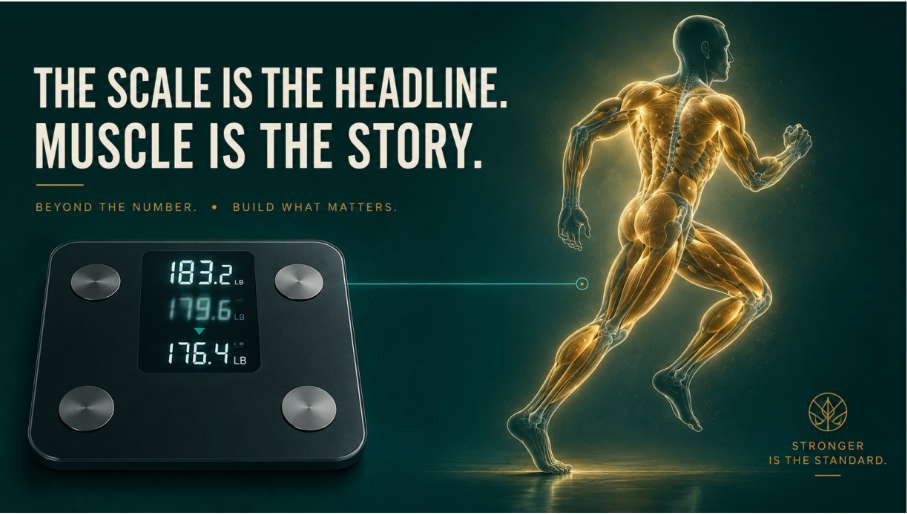
On a GLP-1, pounds fall fast — but a shrinking number hides a more important question: how much of that lost weight is fat, and how much is the muscle you’ll want for the next forty years?
The fine print your bathroom scale can’t read
DEXA scans from the pivotal trials answer it. In recent incretin studies, lean soft tissue has accounted for roughly 25% to 40% of total weight loss, depending on the drug and population. In one careful re-analysis, STEP 1’s semaglutide arm lost about 45% of its total weight as lean mass; in SURMOUNT-1, tirzepatide’s figure was closer to 26%. This is not a scandal — some lean-tissue loss during any weight loss is normal and partly adaptive, as a Mendelian-randomization analysis of more than 800,000 people confirmed: incretin-like signaling reduces both fat and lean mass, but fat loss dominates, yielding a net-favorable body composition. The SEMALEAN cohort even found that grip strength improved and sarcopenic obesity fell from 49% to 33% over a year.
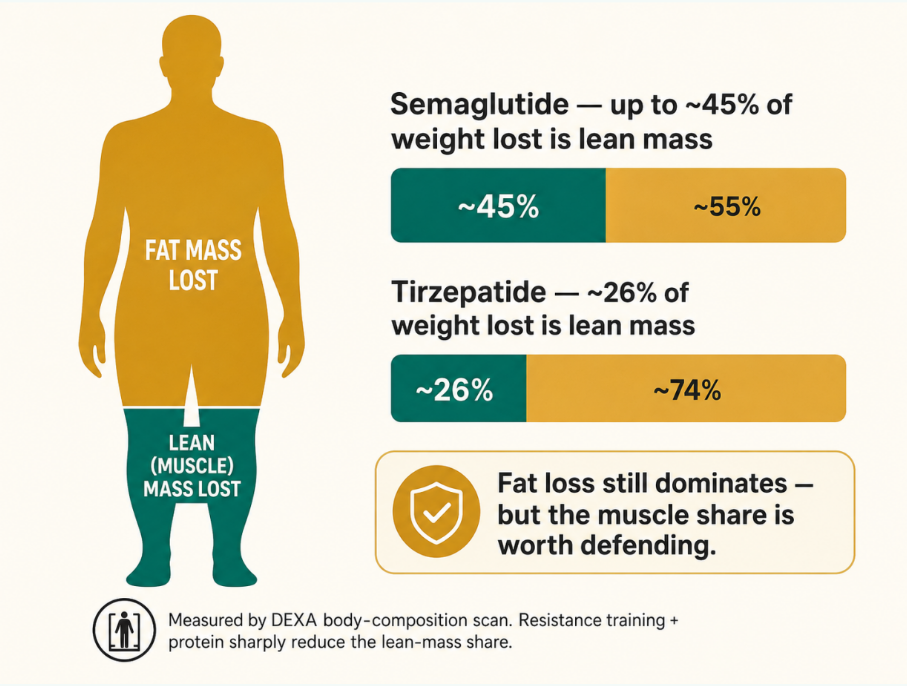
Not a scandal, but not a free lunch: across the major trials, roughly a quarter to two-fifths of the weight lost on these medications can come from lean tissue — the exact fraction you can shrink with protein and resistance training.
The concern is concentration and context. Lose 20 kilograms in a year, and even a “normal” proportion of lean loss is a large absolute number — and it lands hardest on exactly the people longevity medicine cares about most. Obesity-medicine specialists describe the pattern candidly: powerlifters and recreational-league athletes on
semaglutide or tirzepatide often return to the clinic reporting that their lifts have stalled and they feel weaker, especially those who began with more muscle to lose. The fix is not mysterious. The athletes who force protein and keep training tend to hold — or even improve — strength while shedding 15 to 25 pounds of fat.
Stuart Phillips, the McMaster kinesiologist and Tier 1 Canada Research Chair in skeletal muscle health with more than 400 papers to his name, frames the risk with characteristic restraint: it is too early to know whether GLP-1–related muscle loss will prove clinically harmful long term, but the sensible posture is to proceed with caution, especially in older persons.
His metaphor for why is worth keeping — muscle is a labile reserve of amino acids, a bank the body raids whenever protein runs short, whether from a crash diet, chemotherapy, or an appetite dialed to near-zero by a weekly shot.
The reframe that changes everything. The goal of someone on a GLP-1 is not to lose weight. It is to lose the right weight — to route the deficit toward fat and defend the tissue that sets your resting metabolic rate, insulin sensitivity, glucose disposal, and how many of your later decades you spend under your own power. Muscle is the currency of an active old age. Protein and training are how you keep it in the account. And this, precisely, is where a skilled coach, dietitian, or clinician stops being a luxury and becomes the difference between a good outcome and a great one.
Protein: the master lever
Protein earns its status as the master macronutrient for two independent reasons, and a GLP-1 amplifies both rather than replacing them.
First, satiety with a twist. Gram for gram, protein is the most satiating macronutrient, and the mechanism is almost poetic: protein and its digestion products stimulate the gut’s own satiety hormones. Controlled studies show high-protein meals raise peptide YY and — here is the twist — endogenous GLP-1 more than isocaloric carbohydrate or fat. Reviews of gut physiology confirm the full cascade: amino acids in the intestinal lumen trigger cholecystokinin, the incretins GIP and GLP-1, and PYY. In laboratory models, the short peptides liberated when you digest a chicken breast themselves stimulate GLP-1 secretion. A well-built plate, in other words, nudges the same pathway the medication floods. (An honest note, because this is science and not a supplement label: the leap from “hormones rose” to “ate less later” is real over the intermeal window but not perfectly linear in every study — appetite is a committee, not a dictator.)
Second, structure. Protein supplies the amino acids — leucine above all — that switch on muscle protein synthesis (MPS). During a caloric deficit, synthesis falls, and breakdown rises; adequate protein plus a resistance stimulus keeps the ledger from tipping into net loss. Which brings us to the number that separates people who “eat plenty of protein” from people who actually build something with it.
The leucine threshold: why timing beats totals
Muscle protein synthesis is not a dimmer you nudge upward with every bite. It behaves like an ignition. Below a certain dose of leucine in a single meal, the response is weak; cross the threshold and MPS fires maximally; pile on more, and you mostly plateau. That threshold — traceable to Moore and colleagues’ dose-response work — sits near 2.5 grams of leucine per meal for younger adults and closer to 3 grams past 65, because aging muscle develops “anabolic resistance” and needs a louder signal to hear the same instruction.
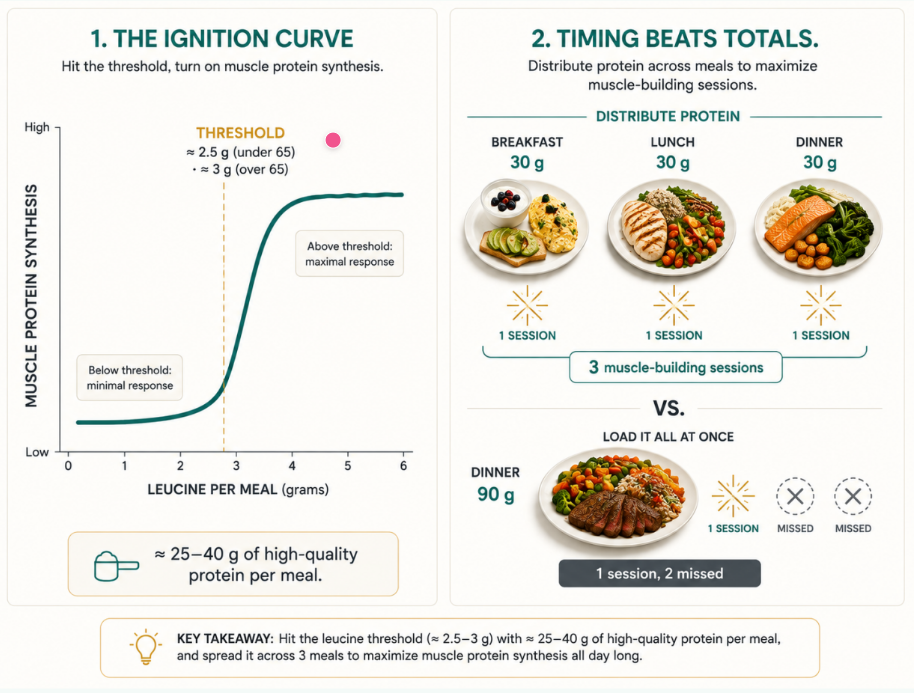
Muscle-building is an ignition, not a dimmer. Three meals that each clear the ~2.5–3 gram leucine threshold beat one giant dinner at the same daily total, which is why front-loading protein matters most on an appetite-suppressing medication.
In real food, that translates to roughly 25–40 grams of high-quality protein per meal — one palm-sized chicken breast, Greek yogurt stacked with eggs, or a whey shake (whey is the most leucine-dense practical protein at ~10–12% leucine by weight).[14] The consequence for GLP-1 users is enormous. The classic pattern — toast-and-coffee breakfast, a nibbled lunch, most of the day’s protein at dinner — can hit a respectable daily total while missing the per-meal threshold at two of three meals. Each meal is its own MPS session; skip the dose, skip the session. On a medication that suppresses appetite hardest earlier in the day, front-loading protein isn’t fussiness. It’s the whole game.
Design principle a good coach installs first: three meals that each clear the leucine threshold (call it 30–30–30 grams) beat one 90-gram dinner, even at identical daily totals. For older adults, nudge each meal to 35–40 grams. It is the highest-leverage, lowest-cost change most people never make on their own.
How much — and the training that makes it count
The 0.8 g/kg RDA was set to prevent deficiency in sedentary adults, not to defend muscle in someone deliberately under-eating on a GLP-1. Under active weight loss, the evidence converges higher. Murphy and colleagues showed at least 1.6 g/kg/day is needed to maximally preserve lean mass in an energy deficit; the International Society of Sports Nutrition endorses 1.4–2.0 g/kg for people doing resistance training; 2025 clinical guidance for GLP-1 users clusters around 1.2–1.6 g/kg/day, and sports-medicine sources push athletes toward the 1.6–2.2 g/kg end. For a 90-kg person, that is roughly 110–200 grams a day — often two to three times what an appetite-suppressed patient eats without a plan. One caveat that proves the point about individualization: patients with chronic kidney disease need targets set with a nephrologist, not a blanket “eat more protein.”
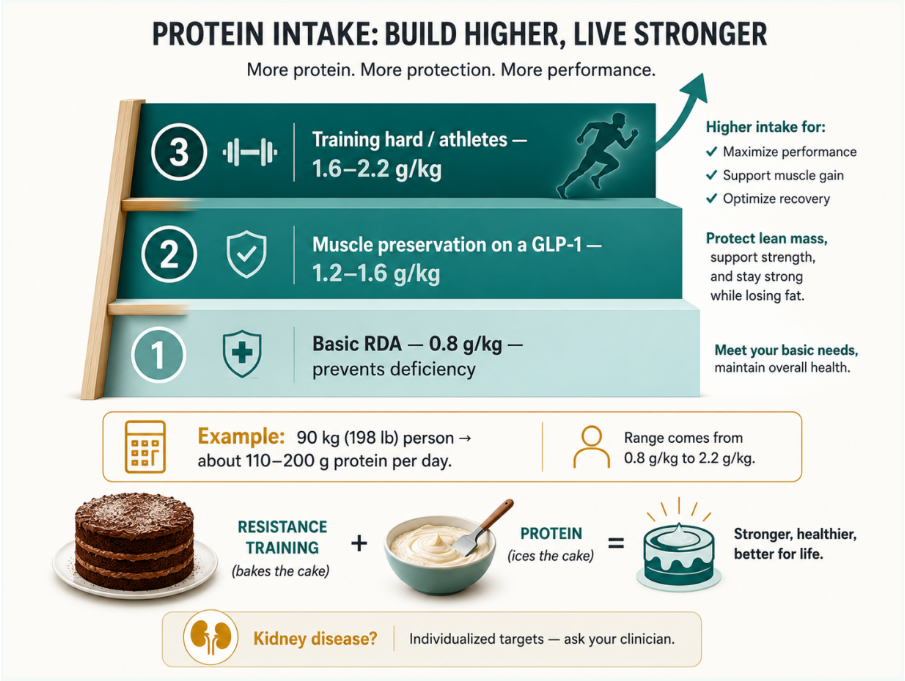
The old 0.8 g/kg RDA prevents deficiency; defending muscle through a medically driven deficit takes considerably more. As muscle expert Stuart Phillips puts it, training “bakes the cake” and protein “ices” it — you need both.
And protein alone will not save the muscle. This is the sentence Stuart Phillips has spent a year reinserting into an overheated conversation, and it remains the most quotable line in the field: “The lifting and the exercise bakes the cake, and the protein ices the cake.” Resistance training is the signal that tells a body in deficit that its muscle is a load-bearing infrastructure worth keeping; protein is the raw material that lets it comply. Published case series of patients who preserved lean mass on these drugs share one denominator — structured resistance training three to five days a week, not powder alone. A 2025 review put it plainly: exercise, especially resistance training, is what preserves muscle and sustains the loss after the drug stops.
Here, the practitioner becomes indispensable, and the science quietly flatters the profession. Formal guidance for certified trainers now instructs them to program multijoint lifts and progressive overload for GLP-1 clients and to collaborate with registered dietitians on protein targets of 1.2–2.0 g/kg. A performance coach who understands leucine timing, a nutritionist who can engineer 35 grams of protein into a nauseated client’s breakfast, an executive coach who reframes “the drug does the work” into “the drug buys you the opportunity to build” — these are not accessories to the medication. They are the operating system that determines what they produce. The weight-loss coach, the dietitian, and the clinician are where molecular science becomes a human result.
Read More Scientific Research from LongevityPlan.AI.
Buy Peptides from LongevityPlan.AI.
The ten sources, decoded
With the mechanism established, the grocery list becomes a tool. These ten anchor proteins are ordered less by raw grams than by how efficiently they cross the leucine threshold, how well they suit a shrunken appetite, and what they add beyond protein. Values are approximate per common serving.
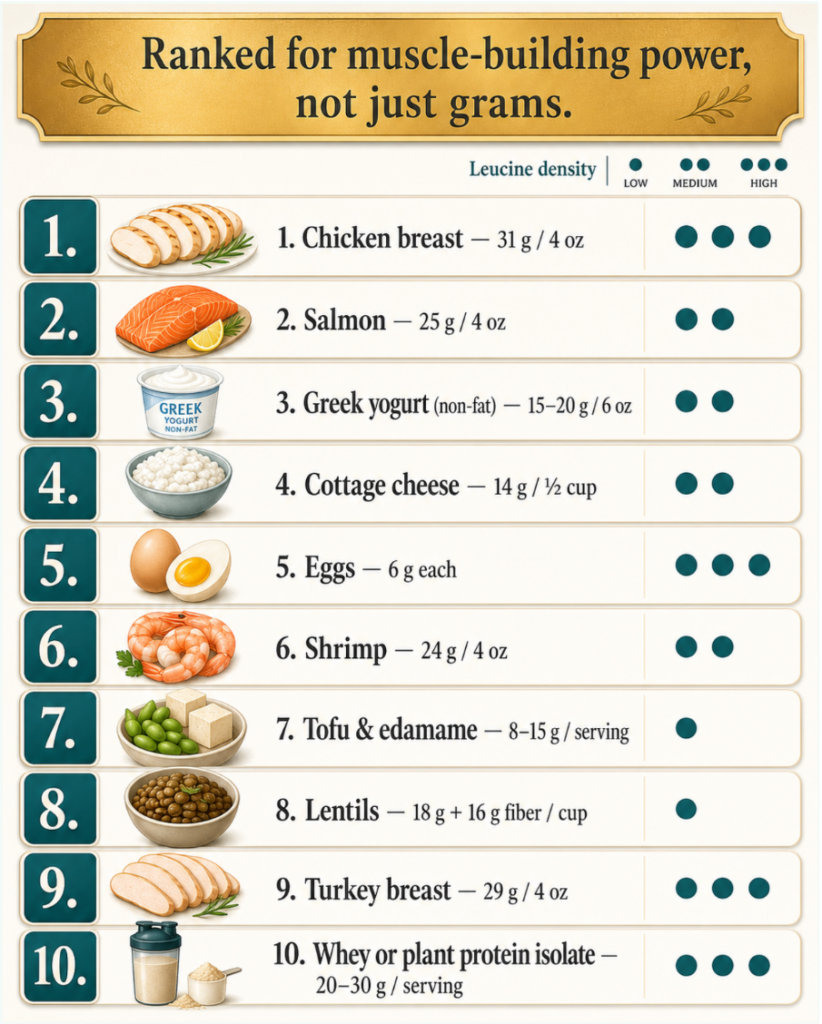
The best protein on a GLP-1 is often the one you’ll actually finish. This ranking rewards leucine density, digestion speed, and tolerability at low appetite — not raw grams alone.
- Chicken breast (~31 g / 4 oz). The workhorse: lean, leucine-rich, satiating. One palm-sized portion clears the threshold for most adults — your highest signal-to-volume solid food when appetite is small.
- Salmon (~25 g / 4 oz). Slightly less protein than poultry, paired with long-chain omega-3s that support the cardiovascular and anti-inflammatory terrain, longevity depends on. A strategic swap two or three times a week.
- Plain non-fat Greek yogurt (~15–20 g / 6 oz). Fast whey plus slow casein and gut-supportive probiotics. Easy to eat when solid food feels like a chore — the common GLP-1 morning problem.
- Cottage cheese (~14 g / 1⁄2 cup). Predominantly casein, digested slowly — ideal before the overnight fast, the longest stretch your muscle spends in negative balance.
- Eggs (~6 g each). Modest per unit but exceptionally leucine-dense and complete; two or three eggs plus a dairy side is a reliable threshold-crossing breakfast that defeats the toast-and-coffee trap.
- Shrimp (~24 g / 4 oz). Ultra-lean and low-calorie — perfect when the caloric budget is tight but the protein target isn’t negotiable.
- Tofu & edamame (~8–15 g / serving). Soy is the plant kingdom’s most complete protein, and matched meals of plant- and animal-based protein produce comparable GLP-1 and PYY responses. Plant-forward eaters simply aim a little higher on total to match leucine.
- Lentils (~18 g + 16 g fiber / cooked cup). Protein plus a large fiber dose supporting satiety, insulin sensitivity, and the microbiome — three longevity levers in one bowl. Lower in leucine, so pair with a dense partner.
- Turkey breast (~29 g / 4 oz). Chicken’s equally lean cousin; rotate it to fight palate fatigue, a real adherence risk on any long protocol.
- Whey or plant protein isolate (~20–30 g / serving). The pragmatist’s insurance policy. During dose titration, when nausea makes whole food unappealing, a shake delivers a threshold-crossing leucine dose in a volume a suppressed appetite can tolerate — often the single most useful tool on a hard day. Notice what the ranking rewards: leucine density, digestion kinetics, and tolerability at low appetite. On a GLP-1, the best protein is frequently the one you’ll actually finish.
Peptides: speaking the body’s own language
Here, the word peptide stops being biohacker jargon and becomes the connective idea of the whole story. A peptide is simply a short chain of amino acids — a signaling molecule, often one that the body already makes. GLP-1 receptor agonists are peptides, arguably the most successful therapeutic peptides in medical history, modeled on a hormone your own intestinal L-cells secrete, with the first-in-class exenatide famously derived from a compound in the venom of the Gila monster. The lesson of the GLP-1 era is that well-chosen Peptide Therapy can move human physiology with a precision diet and willpower rarely match — and the pipeline aimed squarely at body composition is deep and, for once, genuinely exciting.
The muscle-preservation frontier. The thesis is elegant: if incretins strip some muscle with the fat, pair them with an agent that protects it, and you sell quality weight loss. The lead candidate has been bimagrumab, an antibody that blocks activin type II receptors to promote muscle growth — discovered by Novartis, revived by the startup
Versanis Bio, and acquired by Eli Lilly for up to $1.9 billion. In the randomized BELIEVE trial, bimagrumab plus semaglutide drove up to 17.8 kg of weight loss while preserving lean mass and preferentially stripping visceral fat. Regeneron’s myostatin antibody trevogrumab boosted muscle preservation by about 51% versus semaglutide alone, rising toward 81% when stacked with a second antibody; Veru’s selective androgen receptor modulator enobosarm cut lean-mass loss by 71% (relative) alongside semaglutide in Phase 2b. And in a preview of where discovery is heading, Lilly committed up to $650 million to Juvena Therapeutics to use its AI platform to find novel muscle-maintaining molecules — machine learning pointed not at ad targeting but at the proteome.
Beyond the incretins. The broader peptide toolkit that coaches, dietitians, and longevity clinicians increasingly field questions about spans a useful spectrum of evidence, and the honest map is itself the value a good practitioner provides. At the strongest-evidence end sits tesamorelin, a growth-hormone-releasing-hormone analog FDA-approved as Egrifta since 2010. In pooled Phase III trials of more than 800 patients, it reduced deep visceral abdominal fat by roughly 15–18% at 26 weeks versus placebo — measured by CT, a far harder endpoint than the scale — while its downstream IGF-1 signaling helped preserve lean mass during the fat loss. Because it prompts the pituitary to release growth hormone in the body’s own pulsatile rhythm rather than flooding it with synthetic hormone, it illustrates the central promise of peptides: work with physiology, not over it.
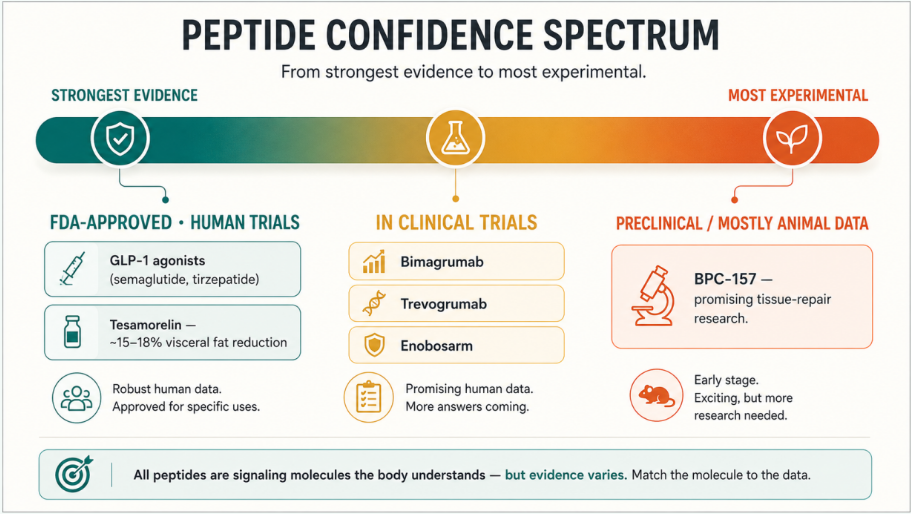
Peptides run a continuum from rigorously trialed (GLP-1 agonists, tesamorelin) to promising-but-preclinical (BPC-157). Knowing where each one sits — and neither overselling the early ones nor ignoring the proven ones — is exactly the expertise a good practitioner brings.
Further along the frontier — thinner on human data but rich in preclinical promise — sits BPC-157, a pentadecapeptide originally isolated from gastric juice. Across a large body of animal studies, it has accelerated the healing of muscle, tendon, ligament, and bone; promoted new blood vessel growth and collagen synthesis; dampened inflammatory signaling; and, intriguingly for anyone building muscle, upregulated growth hormone receptor expression in tendon cells. In rats, treated Achilles tendons showed higher load-to-failure and better functional recovery. Human evidence remains limited to a handful of small pilot studies, which have reported no major adverse events but cannot yet confirm the animal results — an important honesty that a responsible Coach / Practitioner conveys rather than glosses over. Still, the mechanistic story is compelling: a naturally derived molecule that helps damaged tissue rebuild is exactly the kind of recovery ally that could let an athlete or an older patient train harder and more often — and training, remember, is what protects the muscle in the first place.
The through-line matters more than any single molecule. Peptides span a continuum from FDA-approved and rigorously trialed (e.g., GLP-1 agonists, tesamorelin) to preclinical and off-label (e.g., BPC-157 and much of the wellness market). They are exciting because they borrow the body’s own signaling vocabulary; they demand respect because dose, source, timing, and individual biology genuinely determine the result.
Knowing where each one sits on that continuum — and refusing to oversell the early ones while fully embracing the proven ones — is the expertise that health, performance, and beauty professionals bring to a field crowded with hype. It is also, not incidentally, what separates a durable longevity practice from a supplement stand.
Your genes change the equation
Here is the uncomfortable truth that averages conceal: two people on the same dose of the same peptide, eating the same protein, do not get identical results — and some of that variance is genetic and measurable. Pharmacogenomics is an established field of medicine; the National Human Genome Research Institute notes that more than 98% of people carry a variant that affects how they respond to common medications. The incretin pathway is no exception. Variation in the GLP1R gene — which encodes the very receptor semaglutide targets — has been tied to different weight-loss responses (the variant rs6923761 is a recurring example), and the heavily replicated FTO variant rs9939609 shapes appetite and fat storage. Genetics doesn’t dictate destiny, but it tilts the odds — before a client spends a year and a considerable sum on a protocol.
This is the foundation of what we call the Digital Twin for Predictive Peptide Performance: begin with the individual’s genetic architecture — the receptors, signaling cascades, and metabolic genes a given peptide acts through — and treat that map as the substrate on which everything else is modeled. Peptide-specific pharmacogenomics is younger and less validated than the CYP450-based testing already routine in oncology and cardiology, so it belongs in the “promising and improving” column, not “settled.” But the direction is unambiguous. The question is shifting from “does this peptide work?” to “does it work on someone with your genome?”
From data to decisions: the intelligence layer
Genetics is the foundation, but it is static. The living picture requires feeding a model the streams a body generates every day, which is where a digital twin earns its keep — an accumulating simulation of one person, updated continuously. A sensor layer ingests the raw signals: continuous glucose, heart-rate variability, sleep architecture, DEXA body composition, grip strength, VO2 trends, lab panels, and the food-and-training log. An intelligence layer fuses that multi-modal health data — reconciling a wearable estimate, a bloodwork trend, and a strength benchmark into one coherent state — and applies predictive modeling to the questions that matter: given this genome, this training block, and this protein intake, is lean mass trending toward preservation or erosion? Is protein clearing the leucine threshold at each meal, or only at dinner?
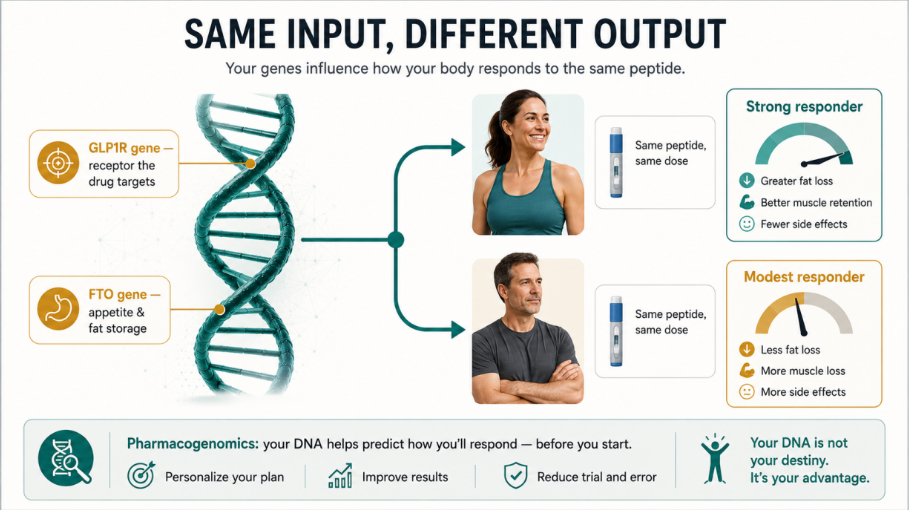
Same drug, same dose, different result. Variants in genes like GLP1R and FTO help explain why — and why the future of peptide therapy starts with reading the individual, not the average.
The output is a stream of AI-powered coaching improvements — small, timed, personalized adjustments instead of generic advice — and it is best understood not as a replacement for the human expert but as a force multiplier for one. The relationship it enables is the one longevity medicine has always wanted: a coach or clinician and an Athlete / Patient looking at the same evolving model of one body, arguing from data rather than anecdote. The same machinery generalizes: a Cardiorespiratory Digital Twin applies identical logic to the oxygen-transport chain, the VO2 and cardiac-output metrics that predict both athletic ceiling and all-cause mortality. Muscle
and aerobic capacity are the two pillars of functional longevity, and both are now, for the
first time, continuously modelable.
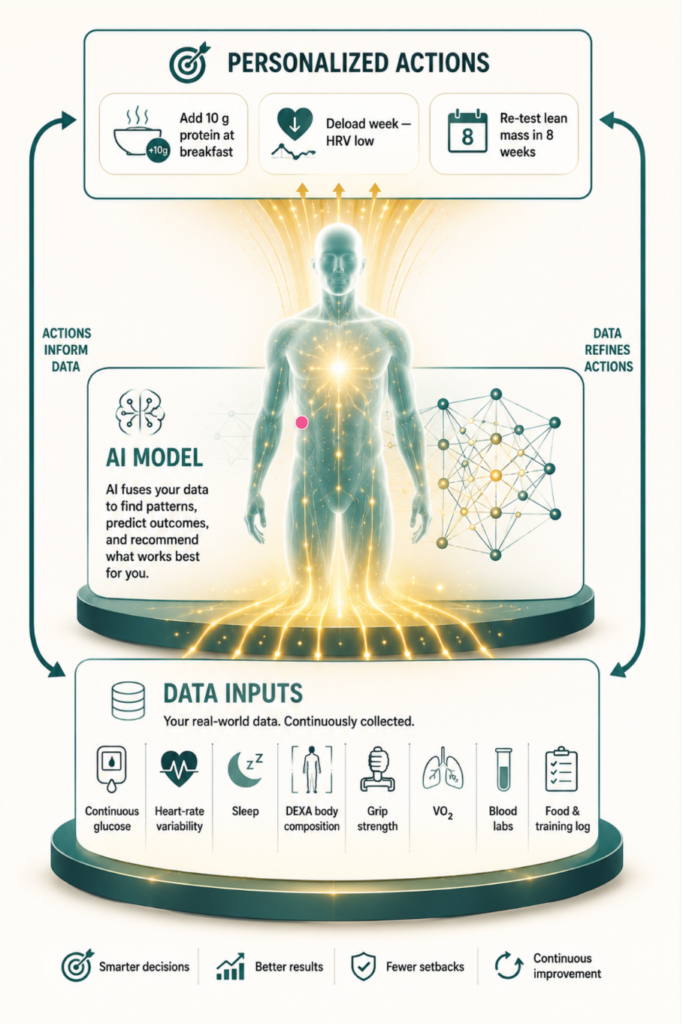
A digital twin is a living model of one person: wearables and labs flow in, an AI reconciles them into a single picture, and out comes a stream of small, timed, personalized adjustments — a force multiplier for a good coach, not a replacement for one.
The expertise premium
How the industry meets this demand splits into two philosophies, and understanding the difference is worth real money.
The diagnostics-first model has democratized testing that once required a five-figure concierge retainer. Function Health (co-founded by Dr. Mark Hyman, $365/year for 100+ biomarkers across two draws, with clinician notes) and Superpower ($199/year, an AI chat layered over results run through Quest Diagnostics) sell breadth; Lifeforce and Fountain Life occupy adjacent ground with clinician access, hormone optimization, and imaging. Their premise is sound — a standard physical measures 10 to 15 markers when 100-plus tell the real story. But breadth has a failure mode worth naming plainly: more biomarkers are not automatically better. A meaningful fraction of some “100+” panels are calculated ratios rather than direct measurements, and consumer “biological age” clocks are, for an individual, a rough directional signal rather than a verdict. Data without interpretation can manufacture anxiety as easily as insight.
Which is exactly why the intelligence-first model — and the human expertise atop it — is where durable value lives. Testing is the raw input; the product is the model that turns disparate measurements into a prediction and a next action, and the practitioner who turns that prediction into behavior a real person will sustain. This is the layer no dashboard replaces. The weight-loss coach who keeps a discouraged client training through the titration weeks; the dietitian who rebuilds a nauseated executive’s breakfast around 35 grams of tolerable protein; the nutritionist and clinician who can tell a proven peptide from a hopeful one — these professionals convert science into results, and their expertise compounds when it sits atop good data rather than guesswork. For a Corporate Wellness Program trying to extend the productive years of an aging leadership bench, or an individual who would rather prevent the fracture than diagnose it, the closed loop — measure, model, act, re-measure, coached by someone who knows the terrain — is the entire proposition. Membership in any serious Longevity Club is, in the end, just the decision to treat your future self as a client worth serving, and to hire the right people to serve them.
A quiet observation for the reader who has come this far: the people who navigate the GLP-1 era best won’t be the ones with the most willpower or the newest injectable. They’ll be the ones who planned — who built the muscle-defending habits, the measurement loop, and the expert relationships before the deficit began. Longevity is the rare domain where the compounding starts the day you decide it does.
Putting it to work
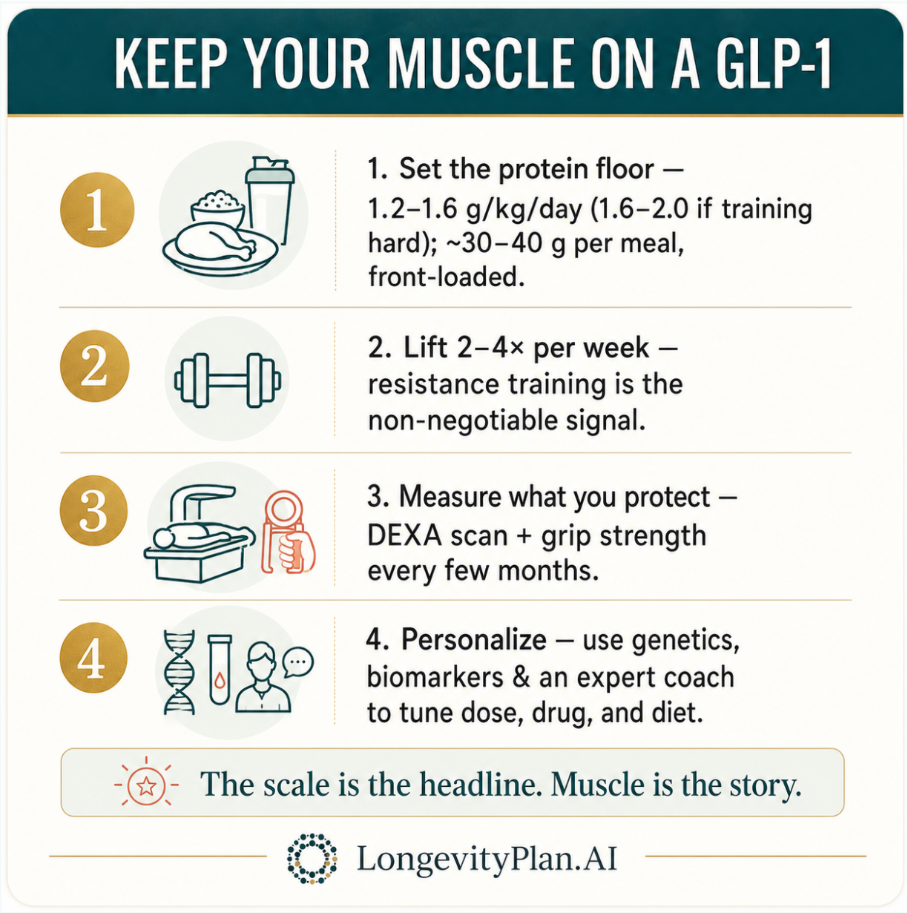
The whole strategy on one card: set the protein floor, lift, measure, and personalize. Simple to say, transformative to do — and far easier with a coach and good data in your corner.
Strip away the machinery and a defensible plan for anyone who wants to keep their muscle through a GLP-1 fits on a card — a starting-point Peptide Longevity Plan to refine with your clinician and coach, not a prescription. Set the protein floor at 1.2–1.6 g/kg/day (toward 1.6–2.0 if training hard), distributed as ~30–40 grams per meal so
each one clears the leucine threshold, front-loaded because appetite is smallest early, with a whey or soy isolate on hand for titration days. Lift two to four times a week — the non-negotiable signal; protein without it is raw material with no blueprint. Measure what you’re trying to protect: a DEXA at baseline and every few months, plus grip strength as a cheap, powerful proxy. And personalize before you scale — use genetic and biomarker data and a knowledgeable practitioner to tilt the dose, drug choice, and protein target toward your biology rather than the trial average.
The GLP-1 revolution is real and mostly wonderful news: durable fat loss, better cardiometabolic risk, and — in the STEP-HFpEF data — genuine gains in how far patients can walk and how they feel. But the medication is a tool, not a plan. It removes the appetite; it does not decide what you do with the deficit. Fill that deficit with protein, load it with resistance training, extend it with a peptide toolkit used wisely, watch it with data, personalize it with your genome, and guide it with real expertise — and you convert a weight-loss drug into something far more valuable: a healthspan intervention. Serena Williams was right that the shot doesn’t diminish the athlete. What you build beneath the weight loss defines you. The scale is the headline. The muscle underneath it is the story.
Sign Up for FREE Daily Longevity Club Workshops
Sign Up for Affiliate Program (Pays 20%)
Subscribe to the Longevity & Peptide Optimization Newsletter
About the Author

Tony Medrano is CEO and co-founder of LongevityPlan.AI, a platform that integrates performance and health data from athletes and leverages proprietary Digital Twin for Predictive Peptide Performance™ technology, wearable data, and biomarker data to deliver personalized performance optimization and longevity recommendations to athletes, coaches, organizations, businesses, government, and the military. In addition to being a 3x technology / AI company CEO with 2 successful exits, Tony has also finished 3 Full Ironman Triathlons (140.6 mi) since 2019. He has degrees from Harvard University, Columbia University, and a JD/MBA from Stanford University.
Tony has been involved with AI and molecular diagnostic start-ups for 10 years, and also worked with the US Olympic Team, National Basketball Association (NBA), National Football League (NFL), Major League Baseball (MLB), Iditarod, FBI, NASA, U.S. Department of Health and Human Services (HHS), Google, Microsoft, Netflix, Bridgewater Associates, ConocoPhillips, British Petroleum, One Medical, and Jenny Craig, Inc. to provide technology, artificial intelligence and/or molecular diagnostics solutions to their employees.
One of Tony’s prior companies provided Conversational AI to health, fitness, and wellness companies; another delivered access to digital libraries of British Petroleum for oil discovery; and his first was a mobile app platform funded by Softbank, which resulted in a case study published by Stanford University Press, and was taught in multiple MBA programs for a decade. Tony loves to teach and mentor; he earned public school teaching credentials in NY and MA and taught inner-city high school students to give back to the underprivileged community in Harlem. He also lectured on entrepreneurship and venture capital to second-year MBA students at Stanford Business School for five years. He co-authored one of the first issued patents for mobile applications. Tony also served as a US Navy Officer commanding an emergency response team on a USN Destroyer. Tony’s military-to-CEO career has recently been chosen to air on an episode of “Operation CEO” a documentary by InsideSuccess.TV, which will air on AppleTV, Prime Video & Amazon MGM Studios, YouTubeTV, and other major platforms worldwide in 2026.
Tony’s Chronological Age is 55, his Metabolic Age is 41, and his Biological Age is 28. He is using a 12-peptide protocol from LongevityPlan.AI that leverages his AI-powered Digital Twin and is currently training for his 4th Ironman Triathlon.
References
- Serena Williams’s GLP-1 endorsement and its implications for athletes (including her statement that it “doesn’t take away from who I am as a professional athlete”). Endocrinology Advisor / USA Today / Women’s Health, Aug 2025. endocrinologyadvisor.com/features/glp-1-use-in-athletes
- Wilding JPH et al. STEP 1 body-composition analysis. Journal of the Endocrine Society. academic.oup.com/jes/article/5/Supplement_1/A16/6240360
- SURMOUNT-1 (tirzepatide) outcomes; body-composition detail summarized in Neeland et al. 2024 (below).
- Neeland IJ et al. Changes in lean body mass with GLP-1-based therapies and mitigation strategies. Diabetes, Obesity and Metabolism. 2024. dom-pubs.onlinelibrary.wiley.com/doi/10.1111/dom.15728
- Mendelian-randomization analysis (>800,000 individuals): GLP-1-like signaling reduces fat more than lean mass. Summarized in ACE Certified, June 2025. acefitness.org/continuing-education/certified/june-2025/8892
- SEMALEAN study: semaglutide, fat/lean mass, grip strength, sarcopenic obesity. PMC12673431. ncbi.nlm.nih.gov/pmc/articles/PMC12673431
- Obesity-medicine specialist observations on powerlifters/athletes on GLP-1s (Dr. Lovato). Endocrinology Advisor, 2025 (as ref 1).
- GLP-1 and the overweight athlete: protein ≥1.6–2.2 g/kg and resistance training as non-negotiable. SportsMD, Dec 2025. sportsmd.com/2025/12/04/glp-1-and-the-overweight-athlete
- Phillips SM. “Preserving muscle with GLP-1 weight-loss drugs.” McMaster University / The Conversation, 2025. news.mcmaster.ca/analysis-preserving-muscle-with-glp-1-weight-loss-drugs
- Phillips SM & Amati F. ZOE Science & Nutrition podcast: muscle as a labile amino-acid reserve; GLP-1 and cachexia. zoe.com/learn/how-much-protein
- van der Klaauw AA et al. High protein intake stimulates postprandial GLP-1 and PYY release. Obesity. 2013. onlinelibrary.wiley.com/doi/10.1002/oby.20154
- Dietary protein and satiety hormones (CCK, GIP, GLP-1, PYY). Frontiers in Endocrinology. 2024. frontiersin.org/articles/10.3389/fendo.2024.1412182/full
- Food-derived protein hydrolysates stimulate GLP-1 secretion in enteroendocrine cells. PMC8877066. ncbi.nlm.nih.gov/pmc/articles/PMC8877066
- Leucine threshold and anabolic resistance (~2.5 g under 65, ~3 g over 65; whey ~10–12% leucine; 25–40 g protein/meal); Moore et al. foundational. Clinical Nutrition Report, 2026. clinicalnutritionreport.com/articles/leucine-threshold-muscle-protein-synthesis
- Murphy CH et al.; ISSN Position Stand (2017); Cava et al. (2017) — protein for lean-mass preservation under energy restriction. Clinical Nutrition Report, 2026. clinicalnutritionreport.com/articles/preventing-lean-mass-loss-glp1
- Protein targets on GLP-1 (1.2–1.6 g/kg; CKD individualization). Fella Health, 2026. fellahealth.com/guide/how-much-protein-to-eat-on-glp-1
- Phillips SM. “The lifting and the exercise bakes the cake, and the protein ices the cake.” Levels podcast, 2026. levels.com/podcasts/why-exercise-secret-muscle-growth-longevity-phillips
- Preservation of lean soft tissue on GLP-1/GIP therapy: case series (resistance training 3–5 d/wk). PMC12536186. ncbi.nlm.nih.gov/pmc/articles/PMC12536186
- Codella R, Senesi P, Luzi L. GLP-1 agonists and exercise: the future of lifestyle prioritization. Front Clin Diabetes Healthc. 2025. frontiersin.org/articles/10.3389/fcdhc.2025.1720794/full
- Guidance for trainers: program resistance training and collaborate with RDs (protein 1.2–2.0 g/kg) for GLP-1 clients. ACE Certified, June 2025 (as ref 5).
- Plant- vs animal-based high-protein meals: comparable GLP-1/PYY responses. PMC12612008. ncbi.nlm.nih.gov/pmc/articles/PMC12612008
- Lilly–Versanis acquisition; bimagrumab; Regeneron trevogrumab; Lilly–Juvena AI deal. BioSpace / BioPharma Dive, 2025. biospace.com/drug-development/lilly-cuts-mid-stage-obesity-study-of-muscle-sparing-ant ibody
- BELIEVE trial: bimagrumab + semaglutide preserves lean mass, reduces visceral fat. Nature Medicine. 2026. nature.com/articles/s41591-026-04204-0
- Veru enobosarm QUALITY Phase 2b (71% relative reduction in lean-mass loss). IQVIA, iqvia.com/locations/emea/blogs/2025/06/beyond-weight-loss
- Falutz J et al. Tesamorelin (Egrifta), pooled Phase III (n≈806): ~15–18% visceral adipose tissue reduction at 26 weeks by CT vs placebo, lean mass preserved; FDA-approved GHRH analog. NEJM 2010; PMC4601733; DailyMed (Egrifta SV).
- BPC-157 preclinical review: angiogenesis, collagen synthesis, muscle/tendon/ligament/bone healing; GH-receptor upregulation in tendon fibroblasts. Int J Mol Sci 2026 (MDPI); PMC6271067.
- BPC-157 narrative review: improved Achilles load-to-failure in rats; human data limited to ~3 pilot studies, no major adverse events. PMC12446177. ncbi.nlm.nih.gov/pmc/articles/PMC12446177
- Pharmacogenomics Fact Sheet — National Human Genome Research Institute. genome.gov/about-genomics/educational-resources/fact-sheets/pharmacogenomics
- GLP1R variant rs6923761 and FTO rs9939609 in incretin/appetite response; peptide pharmacogenomics overview. thepeptidelist.com/research
- Function Health vs Superpower: panels, pricing, Quest partnership, clinician interpretation. Elo Health 2026 review. elo.health/blogs/articles/the-best-comprehensive-blood-biomarker-tests-2026-review
- Critical perspective: “more biomarkers isn’t better”; PhenoAge caveats; calculated-ratio inflation. The Skeptical Cardiologist, 2026. theskepticalcardiologist.substack.com
- STEP-HFpEF: semaglutide improves symptoms, 6-minute walk distance, and physical function in obesity-phenotype heart failure. PMC10504076. ncbi.nlm.nih.gov/pmc/articles/PMC10504076
